




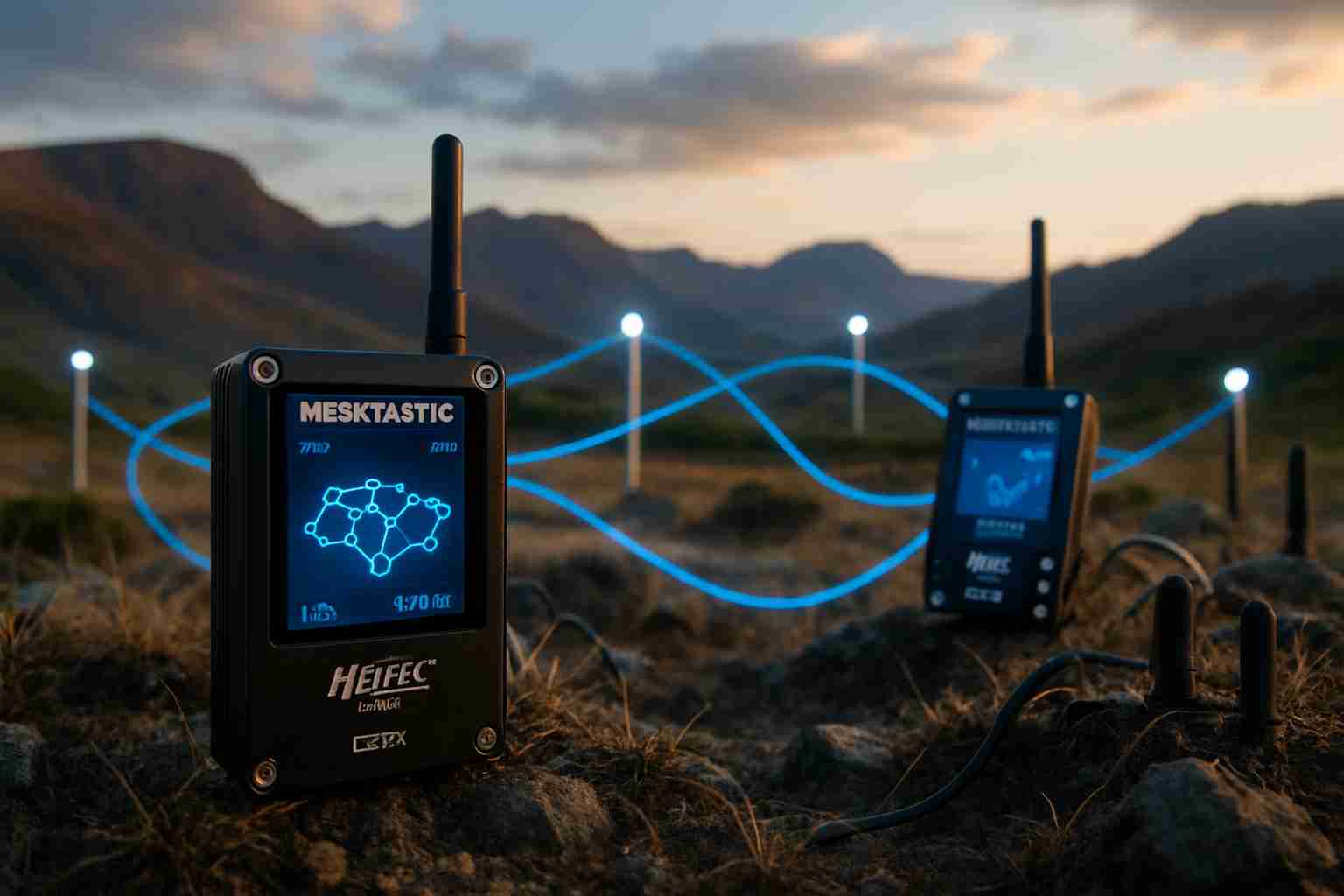
Meshtastic and LoRa mesh networking systems are transforming the way communication is handled in remote environments. Utilizing tools like the Heltec ESP32 V3 and open-source Long Range firmware, these platforms provide dependable, broad-range messaging without depending on conventional networks. This article delves into the details of these technologies, their use cases, and how they enable smooth standalone communication solutions.
The Evolution of LoRa Mesh Networks
In today’s communication arena, LoRa (Long Range) mesh networks have surfaced as an innovative technology, providing a novel approach to connectivity—particularly in isolated network communication units. Unlike conventional systems dependent on centralized infrastructure, LoRa mesh networks function through a distributed wireless networking model, which inherently makes them resilient and adaptable across diverse environments.
Born from the demand for secure, long-distance communication, LoRa utilizes a distinctive modulation approach called Chirp Spread Spectrum (CSS). This method enables signals to cover vast distances while maintaining very low power consumption, solidifying LoRa’s position as a frontrunner in wireless communication—especially in remote or off-grid connectivity solutions. Thanks to its energy efficiency and significant range, LoRa mesh networks have quickly become favored for dependable communication where standard cellular networks fall short.
The strength of LoRa is found not only in its extended-range capability but also in its capacity to operate efficiently with minimal power needs. This capability closes the communication gap in regions with scarce power resources, making LoRa a perfect fit for uses in agriculture, environmental tracking with LoRa technology, and remote data acquisition. Take farmers, for example: they can leverage LoRa to remotely monitor soil moisture across extensive fields without frequent battery swaps or constant electrical supply. This not only streamlines resource management but also supports sustainable farming methods.
LoRa mesh networks have also been revolutionary in environmental surveillance. Deploying standalone environmental monitoring systems widely allows the tracking of climate patterns, soil properties, and wildlife activity. This information is priceless to researchers and conservationists, offering data that was previously difficult to capture due to limitations in power and data transfer.
A defining feature of LoRa is its open-source nature. Unlike many proprietary and costly communication technologies, LoRa’s open-source framework enables community-driven LoRa development. This has sparked a surge of innovative applications and technological improvements, fueled by developers and enthusiasts eager to fully exploit LoRa mesh networking systems.
As we advance in exploring what LoRa mesh networks can do, their adoption spans multiple sectors. Beyond agriculture and environmental sciences, industries such as logistics and transportation utilize LoRa for wireless asset monitoring systems and managing infrastructure. This technology powers real-time tracking and supervision, which are essential for optimizing operations and boosting productivity.
For remote data gathering endeavors—whether scientific or commercial—the lightweight and economical nature of LoRa mesh network deployment is extremely attractive. Researchers can set up sensor arrays in isolated locations to consistently collect and relay data over long periods without frequent upkeep.
In summary, the progress of LoRa mesh networks is transforming connectivity paradigms. By delivering a dependable, low-energy, and broad-coverage solution, LoRa networks not only tackle current communication hurdles but also open the door to novel opportunities in standalone wireless communication. As this technology matures, it’s evident that LoRa will remain instrumental in linking the previously unconnected and driving innovation across various industries with its unparalleled features.
Looking ahead, the next chapter featuring the Lora Meshtastic Node will delve deeper into these topics, illustrating how Meshtastic nodes capitalize on LoRa’s advantages to build decentralized messaging infrastructure, offering uninterrupted communication even where cellular service fails. This discussion will emphasize the impact of collective LoRa technology advancement and open-source development in expanding LoRa’s reach beyond conventional connectivity limits.
Harnessing the Capabilities of Meshtastic Nodes
Meshtastic offers a distinctive, open-source solution utilizing LoRa technology to enable communication where conventional networks fail. Central to this breakthrough is the Lora Meshtastic Node, a crucial element for constructing decentralized communication systems. These nodes allow users to stay connected in isolated locations lacking cellular signals. The core mission of Meshtastic is to deliver a dependable and adaptable toolset for adventurers, trekkers, and anyone requiring communication over vast distances without depending on preexisting infrastructure.
The Meshtastic project’s open-source nature fosters worldwide cooperation, bringing together expertise, creativity, and innovations from both enthusiasts and experts. This collaborative spirit drives ongoing advancements, keeping the protocol at the forefront of autonomous wireless networking technologies. Unlike conventional networks, Meshtastic nodes operate without centralized management; this peer-to-peer architecture guarantees a resilient and flexible network that thrives even in difficult environments.
The community plays a pivotal role in propelling enhancements and securing the project’s practical applicability. With global input, the Meshtastic ecosystem continually evolves, incorporating user feedback and adapting to emerging tech trends. Contributors actively develop and share firmware revisions, create plugins, and produce detailed documentation, all enriching the platform’s functionality and expanding its use cases.
Practically speaking, deploying a Lora Meshtastic Node network involves placing multiple nodes within communication range. These nodes utilize LoRa’s long-distance capabilities to relay messages through the mesh wireless technology until they reach their target. This design permits wide coverage areas, extending communication far beyond the reach of single nodes. The flexibility in node positioning combined with user-friendly operation makes Meshtastic a favored choice for activities in areas where traditional communication methods are inaccessible.
Combining Meshtastic with mobile apps enhances the experience by offering intuitive interfaces for managing the network and messaging. Users can monitor network health, adjust node configurations, and communicate effortlessly. Leveraging these applications makes the system accessible and straightforward regardless of one’s technical background.
The community’s importance cannot be overstated; it is the driving force behind Meshtastic’s ongoing progress. Beyond code contributions, members share enthusiasm and foster innovation, cultivating a dynamic space where ideas thrive. This open-source philosophy unlocks endless opportunities, enabling Meshtastic nodes to support scenarios from emergency response communication systems in remote zones to expeditions into untamed wilderness.
As technology evolves, Meshtastic is positioned to adopt cutting-edge hardware features and continue expanding the limits of autonomous wireless connectivity. The dedicated community ensures the network stays robust, user-centric, and responsive to future challenges.
The Role of Heltec ESP32 V3 in Off-Grid Communication
In the field of standalone communication solutions, the Heltec ESP32 V3 stands out as a central element for establishing LoRa mesh networks. This microcontroller is not only adaptable but also packed with a range of integrated functionalities that combine Wi-Fi, Bluetooth, and LoRa, placing it at the cutting edge of technology in remote communication tools.
The Heltec ESP32 V3 is designed to manage the complexities of contemporary connectivity with impressive effectiveness. Featuring a powerful dual-core processor alongside built-in Wi-Fi and Bluetooth, it represents a strong candidate for crafting communication devices functioning in isolated environments. Importantly, its integration of LoRa technology supports long-distance, energy-efficient communication—critical in situations where conventional cellular networks are unavailable.
Technical Specifications and Capabilities
1. Wi-Fi and Bluetooth Integration: Equipped with dual-mode Bluetooth and advanced Wi-Fi capabilities, the ESP32 V3 facilitates smooth connectivity and interaction with a variety of gadgets. Whether your goal is connecting with smartphones or establishing a local network, its features excel in maintaining reliable connections in demanding settings.
2. LoRa Communication: At its essence, the Heltec ESP32 V3 utilizes LoRa technology, enabling devices to transmit and receive information over vast distances while using minimal energy. This is vital for use cases where power consumption and communication range are paramount, especially in remote locations.
3. Processing Power: Powered by a 32-bit dual-core CPU, this microcontroller efficiently handles several complex operations simultaneously, ensuring high-level processing performance without sacrificing speed or energy efficiency.
Facilitating Off-Grid Communication
The versatility of the Heltec ESP32 V3 opens doors for countless applications tailored to independent communication equipment. By supporting the development of broad LoRa mesh networks, it extends connectivity beyond traditional boundaries. Consider a group of hikers navigating dense woodland – even in areas with weak or nonexistent cellular reception, a network of Heltec units can sustain communication throughout the party, enhancing safety and coordination.
Another key use is environmental monitoring. Deploying these microcontrollers in remote or mountainous zones enables real-time data acquisition. This might involve weather stations sending local climate updates to a central hub across considerable distances, made possible by the Heltec ESP32 V3’s robust functionalities.
Additionally, many models feature Heltec’s OLED display, adding an interactive component that delivers instant feedback and diagnostics crucial during deployment and upkeep.
While Heltec units can function autonomously, their true strength manifests when integrated into mesh networks. These networks not only broaden communication coverage but also reinforce resilience against node failures. Should one device fail, the network architecture reroutes messages via alternative nodes, preserving system integrity—a principle particularly essential in unpredictable independent wireless communication setups.
In conclusion, the Heltec ESP32 V3 is far more than just a microcontroller; it serves as the foundation of a new age in remote wireless communication systems. By merging Wi-Fi, Bluetooth, and LoRa, it harmonizes adaptability with power conservation, crafting a platform ideal for innovative and functional deployments. This empowers users to design sophisticated systems that remain operational when others falter, unlocking the full promise of standalone communication networks for everything from outdoor exploration to vital data-gathering efforts.
Empowering Connectivity with Open-Source Firmware
Open-source firmware serves as the fundamental pillar of flexibility and versatility within LoRa mesh networks, providing an edge that closed-source firmware cannot offer. Essentially, this type of firmware is publicly accessible code that users can modify, powering devices such as the Lora Meshtastic Node. Unlike proprietary firmware, which limits users to a fixed set of features, open-source Long Range firmware encourages exploration, enabling individuals to tailor functionalities and even add new features to fit their unique requirements.
One key advantage of this open platform firmware for mesh systems lies in its promotion of collaborative LoRa development. It unites developers, hobbyists, and tech aficionados globally, all contributing to expanding and refining the firmware’s capabilities. This cooperative spirit sparks faster innovation, facilitating swift bug fixes, improving current features, and inventing entirely new functionalities.
The adaptable nature of open-source Long Range firmware means users are free from the constraints of the manufacturer’s intended device behavior. Instead, they can customize device performance to better match specific environments or integrate with distinct personal or professional setups. In the case of Meshtastic networks, this empowers individuals to fine-tune their nodes’ performance, manage network settings, and apply security measures not typically found in standard commercial products.
Transparency and trust form another essential pillar of open-source telecom firmware. Since users can inspect the code for vulnerabilities or backdoors—a luxury not afforded by proprietary solutions that keep their source hidden—this openness results in secure and dependable networks. Such reliability is particularly vital for contingency communication networks where safety and consistency are critical, like in disaster recovery or remote communications.
Moreover, community-driven firmware projects often offer thorough documentation, guides, and forums, enabling users not just to troubleshoot independently but also to contribute knowledge for others. This shared learning culture fosters inclusivity, welcoming even those with modest technical background to engage actively in advancing and refining their systems.
Devices equipped with open-source communication firmware, such as the Lora Meshtastic Node, illustrate how open innovation fuels technological progress. As users continuously explore novel applications and enhancements, it becomes clear that these open platforms are vital in expanding the capabilities and usability of remote communication tools over time. By adopting this approach, Meshtastic networks broaden connectivity possibilities and empower users to shape technology that truly meets their demands, making off-grid adventures safer and more accessible for everyone.
The Future of Long-Range Messaging
The horizon for Long-Range Messaging is brimming with exciting opportunities, especially as advancements in Lora Meshtastic Node extended-range mesh networking systems continue to progress. These innovations have the potential to transform communication tech, providing a crucial lifeline in situations where conventional infrastructure is unavailable or has failed. Coupling strategic progress in LoRa mesh wireless technology with open-source Long Range firmware is set to reshape our understanding of possibilities in remote communication, catastrophe recovery, and worldwide connectivity.
When considering its technological influence, LoRa’s ability to offer low-energy wide-area network communication is already changing numerous industries. The remarkable aspect isn’t just the distance covered; it’s the creation of a mesh wireless communication that is decentralized and robust. In a world facing increasing climate-related emergencies, the capacity for first responders to stay connected despite the collapse of standard networks is invaluable. LoRa mesh network implementation can be rapidly executed in emergency zones, delivering immediate, reliable, and secure two-way communication. This makes it a vital instrument in disaster resilience communication platforms, filling the communication void exactly when it matters most.
Building on this, open-source low-power wireless firmware plays an indispensable part in keeping these networks flexible. Collective LoRa technology advancement encourages swift innovation and personalization, constantly refining the nodes. Such a collaborative approach fosters a vibrant environment where new capabilities and upgrades can be deployed promptly, outstripping the typically slower cycles of proprietary software. This adaptability ensures these networks function as living ecosystems rather than fixed technologies, primed to address the changing demands of users worldwide.
Given these robust capabilities, it’s understandable why there’s a surge in embracing _Lora Meshtastic Node_. The open-source nature of these networks allows customization across various applications, from environmental data collection using LoRa in isolated regions to delivering connectivity in off-grid locations. Picture explorers maintaining live communication across uncharted landscapes or rural populations accessing communication without hefty infrastructure. As these advantages become more evident, widespread adoption appears inevitable, ushering in a new connectivity era that is both resilient and inclusive.
Looking ahead, priorities in research and development should target improving data transmission efficiency and scaling these networks further. Future forecasts include faster, more dependable communication over greater distances, along with more user-friendly interfaces and experiences. Advances in battery technology will likely yield longer-lasting nodes, reducing the need for frequent recharges and enhancing their suitability for extended deployments.
The potential impact of these technologies worldwide is immense. For regions lacking basic telecommunications, LoRa mesh networks represent not just a chance for connectivity but a significant move toward autonomy. As we continue expanding what these networks can accomplish, their significance in attaining global connectivity grows ever more crucial. Ongoing innovation in this domain is not only expected but essential, as these extended-range LoRa systems carry the promise of narrowing the digital divide and offering more equitable communication access for everyone.
Conclusions
The fusion of Meshtastic, long-distance mesh communication solutions, and open-source LoRa communication firmware is transforming the landscape of independent communication equipment. Users can now tap into durable, extensive communication networks that function without reliance on conventional systems by harnessing innovations in these fields. As these technologies advance, new opportunities arise for deploying them in isolated and demanding environments, setting the stage for upcoming breakthroughs in network connectivity.