


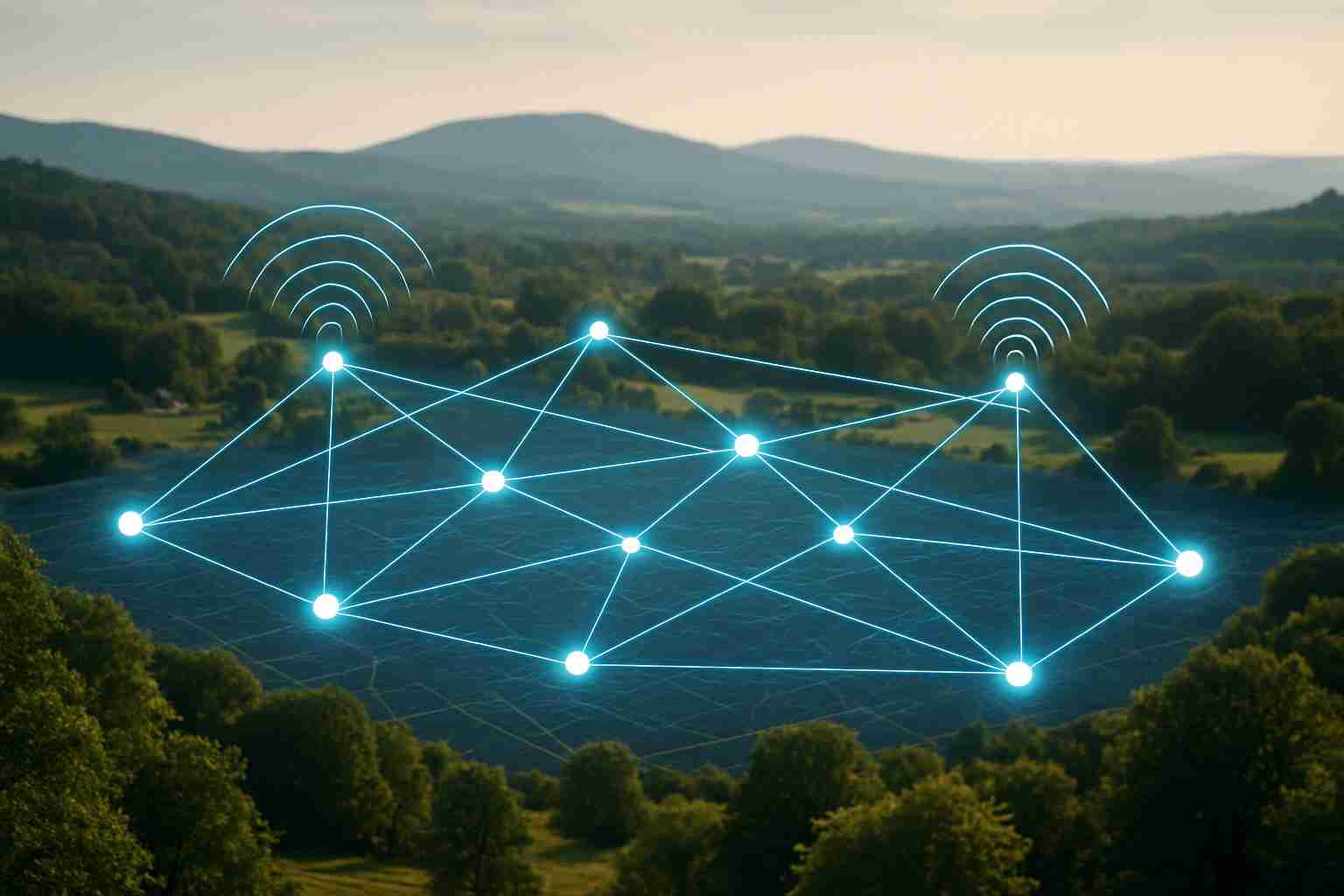
In today’s world, where staying connected is essential, LoRa mesh networks stand out as a groundbreaking approach for autonomous wireless networks. By harnessing distributed telecommunication networks combined with adaptive self-correcting wireless solutions, these frameworks offer dependable and extended-range IoT communication. This article explores the technologies behind LoRa mesh networking and its practical uses, guaranteeing resilient connectivity even in the most isolated network system configurations.
Decoding LoRa Mesh Networks
LoRa, an abbreviation for Long Range, broadens the scope of wireless communication significantly. Utilizing chirp spread spectrum modulation, this radio technology stretches connectivity boundaries, making it an ideal companion for mesh wireless communication. The combination of LoRa and mesh networks creates a remarkable blend of extended distance communication, particularly valuable in standalone wireless solutions.
Within a mesh network, LoRa not only ensures vast coverage but also operates with impressively low energy consumption. This paves the way for devices to stay connected over large areas without relying on constant power sources. By lowering the power requirements, LoRa mesh networks revolutionize sustainable communication technology that is both durable and efficient. Their strength lies in the formation of distributed communication systems that can manage themselves and recover autonomously.
The true success of embedding LoRa into mesh networks is reflected in its versatile use cases. Imagine sensors scattered across a distant forest tracking environmental data or a vast factory deploying Internet of Things connectivity solutions to optimize workflows. In these cases, a LoRa mesh network ensures seamless data exchange between devices, safeguarding against loss caused by distance or power limitations.
This technology shines with its resilience in harsh or complex environments. Whether deployed in mountainous terrains or dense urban settings, LoRa mesh networks thrive where traditional communication systems often fail. Their dependability guarantees that vital information, like weather updates or machinery health reports, is delivered to central hubs promptly, supporting quick and informed decisions.
Moreover, the mesh architecture offers fault tolerance. If a node stops functioning, other nodes automatically reroute data, showcasing the system’s adaptive self-correcting wireless solutions. This inherent robustness means that even during network interruptions, communication remains reliable. It’s a design made not just to connect devices but to adapt and persist.
Sectors utilizing LoRa mesh networks reap the rewards of its flexibility. Fields such as urban infrastructure, farming, and logistics benefit from cost-effective, fast deployments that require minimal power, resulting in enhanced efficiency and reduced expenses. This technology extends the horizon of monitoring capabilities without frequent upkeep.
Ultimately, LoRa mesh networks deliver a trustworthy, far-reaching, and energy-conscious communication framework. Their capacity to maintain stable links across widespread, distributed areas makes them indispensable for improving connectivity in autonomous wireless networks, industrial environments, and remote applications. With such a resilient communication foundation, both adaptability and sustainability in connectivity become tangible and achievable goals.
The Fundamentals of Off-Grid Communication
In our modern era, where staying connected is essential, off-grid communication emerges as a crucial need. Conventional communication methods frequently struggle in isolated or difficult environments such as mountainous terrains, expansive rural zones, or during severe events like earthquakes and hurricanes. This highlights the importance of off-grid communication, which allows communities and organizations to preserve connectivity even when standard infrastructure is compromised, making certain that information moves freely no matter the situation.
Addressing multiple obstacles is the goal of off-grid communication. It primarily reduces reliance on centralized networks vulnerable to single points of failure. In areas where establishing and sustaining communications infrastructure is too costly or environmentally challenging, autonomous wireless networks like the LoRa mesh network serve as an effective alternative. By offering wide-ranging connectivity without centralized infrastructure, it resolves the isolation problem faced by many remote regions.
The value of a LoRa mesh network is in its ability to forge dependable communication links where none existed before. These distributed communication systems are self-reliant, capable of establishing local or regional interaction without dependence on external networks. During emergencies when prompt information is vital, these networks enable rescue teams, medical staff, and affected individuals to communicate rapidly and effectively.
Additionally, such networks are indispensable in military contexts where maintaining undetectable communication lines is often critical. The decentralized wireless mesh systems’ inherent resistance to disruption enhances security and tactical advantages. These systems provide robustness in situations where opponents might seek to dismantle communications infrastructure as a method of warfare.
Off-grid communication technologies also offer strategic benefits regarding environmental responsibility. Typical networks usually need continuous power and extensive physical infrastructure, which can adversely affect local ecosystems. Conversely, solutions like LoRa mesh networks consume less energy and cover large areas with minimal environmental impact. This aligns with worldwide goals toward sustainable development, closing the digital gap without harming nature.
In summary, off-grid communication signifies transformative progress in approaches to connectivity. It guarantees that systems exist for smooth information exchange across diverse and occasionally hostile settings. LoRa mesh networks act as a conduit to connection, supporting resilient frameworks essential for today’s challenges. Whether linking distant populations, aiding disaster recovery, or securing defense communications, off-grid communication lays down a sturdy foundation for ongoing, eco-friendly, and adaptable connectivity.
The Architecture of Decentralized Mesh Networks
Within the swiftly advancing realm of communication technologies, distributed mesh networks have risen as a revolutionary method to provide uninterrupted connectivity without depending on a single failure point. Unlike conventional systems that rely predominantly on centralized routers or fixed infrastructure, peer-to-peer mesh networks facilitate direct interactions between individual nodes. Such a design promotes a robust and adaptable framework, capable of extending connectivity across extensive regions, even amid network segment breakdowns.
A distributed mesh network consists of numerous nodes collaborating to handle and direct data traffic. Each node operates autonomously, engaging directly with nearby nodes to collectively form a dense web of links. This inherently versatile arrangement allows for simple integration of additional nodes, supporting gradual mesh network expansion capability. The interlinked nature of these networks guarantees that information can flow through several pathways, greatly improving mesh network fault tolerance. When one node fails or a connection is lost, data packets reroute via alternative nodes to preserve a steady information stream.
This resilient structure proves essential in many contexts, especially where traditional communication infrastructures are either missing or impaired. For example, during catastrophic events when conventional communication lines might be compromised, distributed mesh networks quickly adapt by transmitting data through intact nodes, ensuring communications stay active. These networks play a crucial role in community-based wireless infrastructures in rural or remote locations, providing internet access and supporting local communications, which aid development and education within those communities.
The fault tolerance and failover strengths of distributed wireless mesh systems are heightened by their capacity to self-organize. Nodes within the network dynamically modify their links and routing algorithms based on real-time evaluations. This autonomous network recovery system makes the LoRa mesh network exceptionally proficient at managing faults or changes without human input, thereby guaranteeing steady and reliable service.
Furthermore, the distributed design aligns perfectly with modern trends emphasizing networking digital autonomy and privacy. By diminishing dependence on centralized data hubs, users retain greater authority over their personal information, fostering a safer communication environment. This empowerment extends to community wireless networks, where users actively contribute to configuring and maintaining the system, democratizing network administration and usage.
Looking ahead, the promise of distributed mesh networks is immense. As worldwide connectivity demands rise and the weaknesses of traditional infrastructure become clearer, incorporating LoRa mesh network features opens a promising avenue for expanding internet reach and availability. Whether enhancing smart urban sensor networks, supporting farm IoT surveillance, or strengthening disaster response communication frameworks, decentralized network models offer game-changing solutions poised to reshape global communication paradigms.
Mastering Self-Healing Mesh Systems
Exploring the self-repairing wireless systems capabilities within advanced mesh networking unveils an intriguing facet of contemporary technology—one where ingenuity meets utility. Within a LoRa mesh network, a self-healing system guarantees robustness and uninterrupted operation by automatically rerouting data whenever interruptions arise. Sensor nodes scattered across the network cleverly identify connectivity breakdowns or malfunctioning nodes and seamlessly redirect information through alternate paths. This flexible behavior renders self-healing mesh network solutions essential for environments that require constant uptime and flexibility, including metropolitan Wi-Fi frameworks and worldwide maritime communications.
One crucial element of these networks is their capacity to operate autonomously, without human interference, thanks to automated network configuration technologies. Software-embedded algorithms within mesh networks continuously analyze their surroundings to determine the optimal routes for data transfer. By independently fine-tuning these pathways, the network mitigates risks linked to centralized system vulnerabilities. This distributed control empowers individual nodes to swiftly restore connections, often more rapidly than manual troubleshooting.
Urban Wi-Fi deployments provide a clear illustration of this. Spanning across city neighborhoods, these setups ensure that both locals and visitors receive constant service. As some elements fail or face interference, the self-healing protocols reduce downtime, allowing data to flow smoothly. Consequently, service interruptions become rarer, and the need for resource-heavy maintenance declines. Nodes can reroute data quicker than a technician’s response time, enhancing overall network reliability.
Similarly, in remote or expansive settings such as maritime communication, self-repairing wireless networks play a vital role. Continuous communication at sea is crucial for shipping, wildlife monitoring, and emergency responses. Thanks to their self-healing prowess, these networks rapidly adapt to shifting conditions, supporting uninterrupted contact between vessels and shore bases, which fosters safety across marine environments.
Such innovations also drive down operational expenses, an important advantage for organizations dependent on mesh networking. By cutting out conventional maintenance bottlenecks and manual setups, companies can fully capitalize on ongoing connectivity. This efficiency not only reduces costs but also bolsters confidence in mesh technology.
In conclusion, the self-healing attributes of a LoRa mesh network redefine network performance expectations. They boost dependability and sustain fluid connectivity, showcasing the system’s resilience and ability to thrive under diverse conditions without human input. This agility cements these mesh networks as pioneers in technological evolution, perfectly aligning with the distributed network frameworks previously examined.
Harnessing Long-Range Radio Communication
The transformation of extended distance radio transmission has been remarkable, fueled by the rise of advanced contemporary technologies. Notably, the idea of long-distance wireless communication has seen a profound overhaul, largely due to breakthroughs in LoRa technology. This innovation plays a crucial role within Low-Power Wide-Area Networks (LPWAN), empowering LoRa mesh network designs that redefine connectivity across expansive distances.
LoRa, an abbreviation for Long Range, enhances radio communication reach while keeping energy use minimal. Such a trait makes it ideal for scenarios demanding data transfer over far-flung locations without frequent battery replacements or excessive power consumption. The core strength of a LoRa network lies in its capacity to efficiently send small data packets over multiple kilometers, cutting through walls and obstacles that typically block other communication forms.
This capability secures LoRa’s leading position in industries like smart farming, intelligent city projects, and health monitoring. For example, in agriculture, IoT devices integrated with LoRa track soil moisture and plant health, advising farmers on irrigation and harvest timing without requiring costly, large-scale infrastructure. Smart city applications utilize this technology to regulate resources such as lighting and parking through connected sensors, boosting urban efficiency. Likewise, remote health monitoring devices exploit LoRa’s long-distance wireless communication to keep medical professionals updated on patient vitals beyond urban centers, enabling swift medical responses.
When assessing long-range radio communication systems like LoRa against conventional methods, several key distinctions emerge. Primarily, LoRa’s scalability surpasses traditional frameworks, supporting many devices without the need for massive infrastructure growth. Older systems often require extensive physical networks to match this coverage, leading to higher expenses and environmental footprints. Conversely, LoRa setups demand minimal installation, encouraging sustainable communication practices aligned with green communication technology principles.
Moreover, LoRa’s low energy consumption and resilient communication features prove invaluable where standard systems struggle, such as in challenging terrains or crowded urban environments plagued by interference. This technology guarantees dependable data flow, essential for uninterrupted operations in remote and dynamic settings.
Together, these elements highlight the effectiveness of wide-area radio networking in revolutionizing global communication standards. As exploration of this technology’s far-reaching applications progresses, it’s evident the adventure has only just started. Long-distance wireless communication, showcased by implementations like the LoRa mesh network, ushers in a fresh epoch of connectivity, where great distances no longer hinder seamless and efficient communication.
Conclusions
LoRa mesh networks offer a thorough answer to the communication obstacles faced in rural and autonomous wireless networks. Utilizing distributed communication systems along with adaptive self-correcting wireless solutions and extended-range IoT communication, these networks provide sturdy and effective connectivity. As advancements continue, LoRa mesh networks are set to become essential components of eco-friendly communication systems that foster durable and resilient global communication, significantly transforming how we interact and exchange data.